
THE BRIDGETOWN INITIATIVE
HISTORY
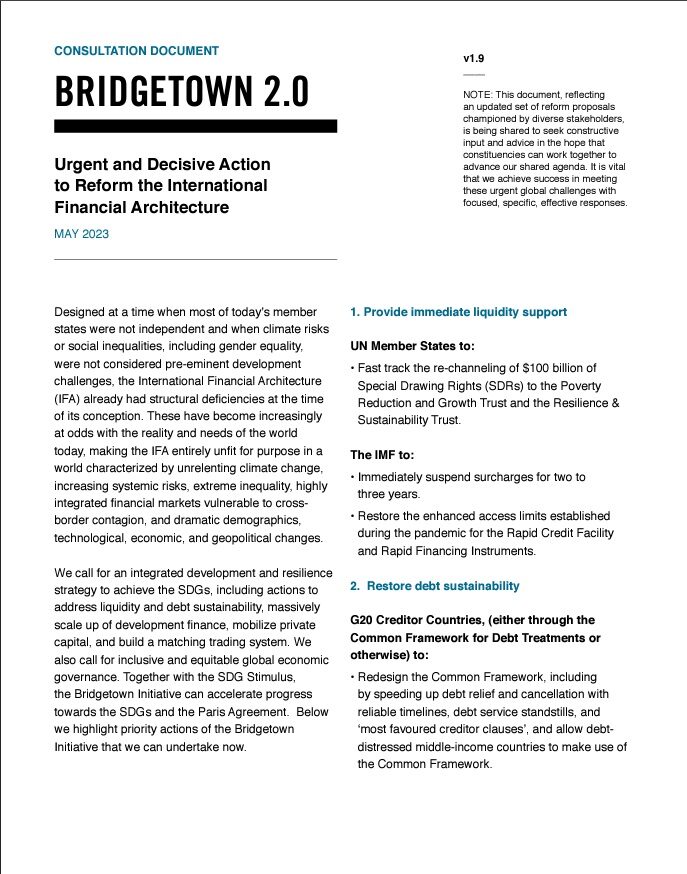
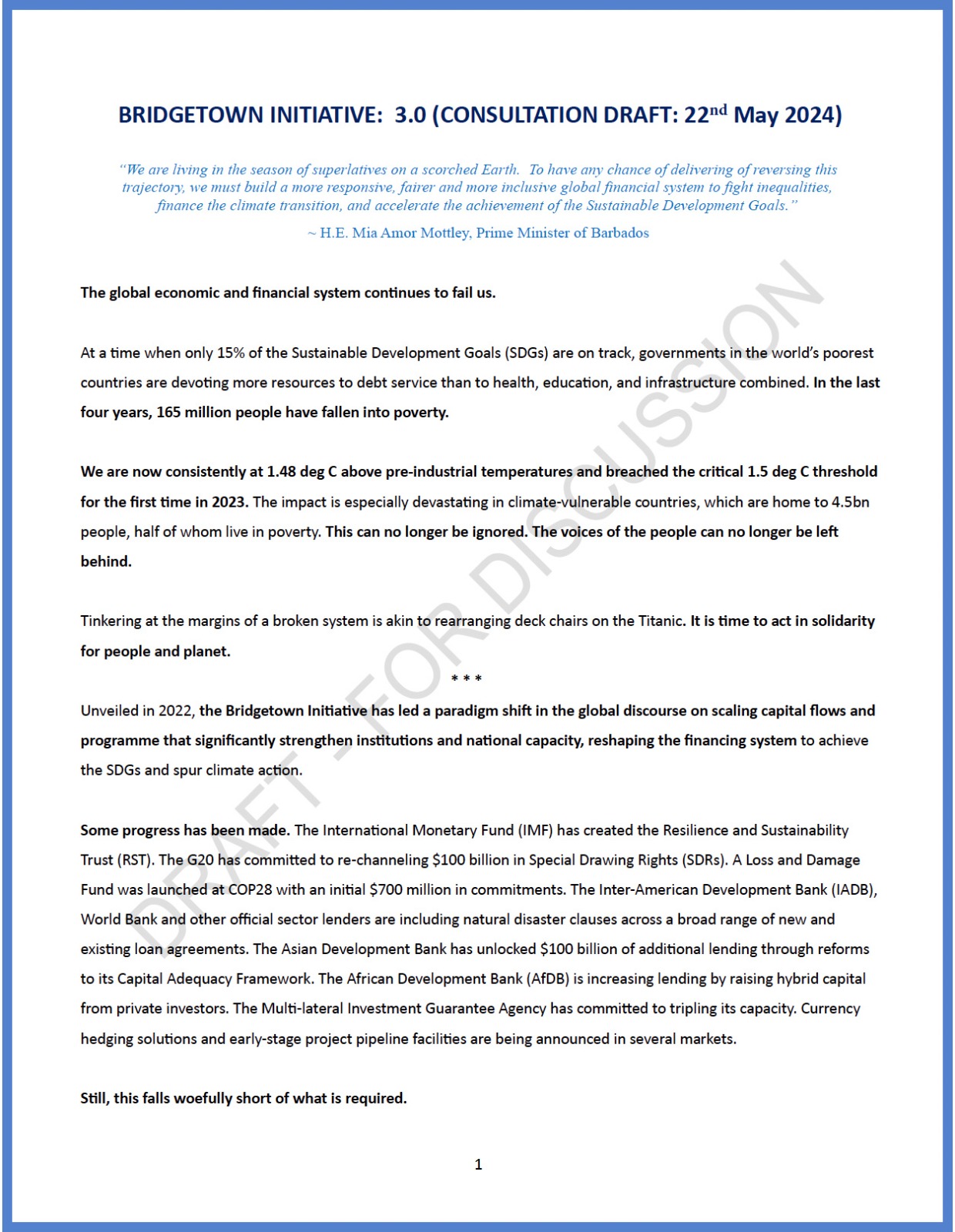
In July 2022, Prime Minister Mottley convened a high-level retreat in Bridgetown, Barbados, which resulted in the Bridgetown Initiative. What began as a loose set of ideas and calls for change coalesced and was initially codified as the Bridgetown Agenda, and then subsequently renamed the Bridgetown Initiative. Details are evolving as the work proceeds, with the first update – Bridgetown Initiative 2.0 – released in April 2023. The second update – Bridgetown Initiative 3.0 – is in progress.
In 2022, key moments in launching and highlighting the Bridgetown Initiative included PM Mottley’s addresses at the UN General Assembly (UNGA77) and the UN Climate Change Conference (COP27).
In 2023, the Bridgetown Initiative (version 2.0) featured prominently in the discussions and influenced the resulting agreements at the June 2023 Paris Summit (resulting in the Paris Pact for People and Planet) and at the December 2023 Climate Change COP28 (the BI was influential both in the negotiations as well as the UAE Leaders’ Declaration on a Global Climate Finance Framework).

Key Contributions and Successes
TO DATE
- Inclusion of debt pause clauses across World Bank loans to Small States Exemption Countries which has in turn inspired other development banks and bi-lateral lenders (e.g. Australia, Spain), and featured prominently as Fourth Financing for Development Conference Platform for Action.
- Commitment from bilateral donors to offer bilateral guarantees to World Bank Group to scale debt swaps.
- Recognition of insurance as a key enabler to close the climate finance gap, with quantified potential contribution of the industry recognized at COP30.
- Re-channeling $100 billion of Special Drawing Rights to the Poverty Reduction and Growth Trust and the Resilience and Sustainability Trust.
- Reducing World Bank equity-to-loan ratio from 19% to 18%, providing an additional $30bn in financing.
- Review of the IMF’s surcharge policy to reduce burden on client countries.
- Advancing ADB reforms based on the Capital Adequacy Framework helping unlock $100 billion of additional lending.
- Increased lending by AfDB through hybrid capital from private investors.
- Advancing AfDB’s work to leverage debt swaps as an instrument to unlock financing.
- Mobilizing bilateral donors o support debt swaps for the first time.
- World Bank commitment to triple guarantee capacity through MIGA, and other guarantee providers are scaling local currency offerings.
- Currency hedging solutions and early-stage project pipeline facilities announced, with support from pooled philanthropic funds.
- IDA replenishment of $100 billion.
- Influenced other platforms, including G20, V20, FfD4, COP30, 4Ps.